 splendo
For visual creators, a model comparison should route real shots instead of declaring one universal winner. Start with the constraint that cannot fail—cinematic ceiling, native audio, character motion, reference control, turnaround, or cost per approved second.
Disclosure: I work with PixMind.
Key Takeaways
- Best value: MiniMax H3 at $0.13/sec (2K) delivers the highest quality per dollar, roughly one-third of Veo 3.1's published rate and about 23% below Kling 3.0.
- Best absolute quality: Veo 3.1 leads on 4K cinematic finish and synchronized audio, but caps clips near 8 seconds.
- Best for motion reuse: Kling 3.0's motion-transfer feature (1080p, $0.168/sec with audio) is unmatched for retargeting a known move onto new characters.
- Open-weight option: H3 is the only one of the three you can self-host, which matters for developers with privacy, latency, or cost-at-scale constraints.
- Audio is no longer a tiebreaker: all three ship native audio (H3 stereo, Kling and Veo synchronized), so the decision now hinges on resolution, length, price, and control.
Quick verdict by job
Lead with the job you need done, then pick the model. Each of these three wins a specific production scenario.
- Batch short-form content (TikTok, Reels, Shorts) on a budget: MiniMax H3. The 2K output is more than enough for vertical social, the 5 to 15-second range covers most hooks, and the per-second price keeps iteration cheap.
- Premium hero shots and brand film: Veo 3.1. When one shot has to look like a finished TV spot at 4K, Veo 3.1's cinematic quality and sync audio justify the premium.
- Reusing a real performance or camera move: Kling 3.0. Its motion-transfer feature takes a reference video's motion and applies it to a new subject, which neither H3 nor Veo does as directly.
- Self-hosted or privacy-sensitive pipelines: MiniMax H3. The open weights mean you can run it on your own infrastructure instead of sending prompts through a third-party API.
The three models at a glance
The table below collects the verified specifications for all three models, checked against MiniMax's official release notes, Kuaishou's Kling 3.0 documentation, and Google's Veo 3.1 product page as of August 2026.
Specification MiniMax H3 Kling 3.0 Veo 3.1
| Max resolution | 2K | 1080p | 4K
| Clip length | 5 to 15 seconds | 3 to 15 seconds | ~8 seconds
| Native audio | Yes, stereo | Yes, included in price | Yes, synchronized
| Reference inputs | Up to 12 | Motion-transfer reference | Standard text/image
| Standout capability | Multi-reference consistency, open weights | Motion transfer | Cinematic 4K finish
| Pricing model | $0.13/sec at 2K | $0.168/sec (audio included) | Premium per-second rate, higher than H3 and Kling
| Access | Open weight + hosted API | Hosted API | Hosted API (Google)
| Best for | High-volume, cost-sensitive production | Retargeting real motion | Hero shots and brand film
MiniMax H3 in Action: Real Comparison Examples
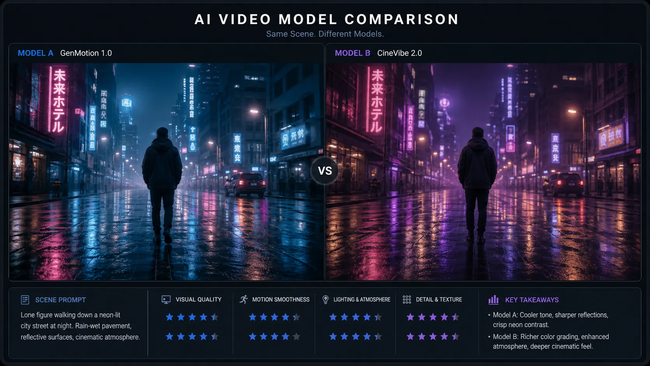
Before the deep dive, watch the models run head to head. The video below is a side-by-side MiniMax H3 versus Veo comparison that renders the same prompt through each model, so you can see where each one actually wins on screen.
https://www.youtube.com/embed/fU5uFVIzp_c" width="560" height="315" title="MiniMax H3 vs Veo 3 AI video comparison" frameborder="0" allow="accelerometer; autoplay; clipboard-write; encrypted-media; gyroscope; picture-in-picture" allowfullscreen> A side-by-side comparison renders the same prompt through MiniMax H3 and Veo to show where each model wins on detail, motion, and cinematic finish.
MiniMax's own positioning places H3 ahead of Veo and Kling on the price-to-quality curve, which is the claim the comparison video above puts to the test.
https://x.com/RyanLeeMiniMax/status/2082999154029306266">MiniMax H3 rankings vs Veo and Kling
MiniMax H3: open-weight 2K with twelve references
MiniMax H3 is the model that reshaped the value ladder in 2026. It is the only one of the three released as open weights, it pushes 2K resolution, and it accepts up to twelve reference inputs at once for identity, action, scene, and sound.
The reference system is H3's real differentiator for storytelling work. Instead of a single image anchor, you can hand it separate references for a character's face, a body or costume, a background, a camera move, and even a voice or ambient track. The model then binds those references across a 5 to 15-second clip, which is what makes it strong for serialized content where a character has to stay recognizable from shot to shot. Independent YouTube creator tests reviewed for this comparison consistently ranked H3 ahead of Kling 3.0 on visual detail, texture fidelity, and character motion coherence.
The trade-off is resolution ceiling. H3 tops out at 2K, so it is not the right tool for a 4K deliverable or a theatrical master. It is, however, enough for almost every vertical social format and most web playback. The native stereo audio is also notable: it is not a bolted-on text-to-speech track but a model-level audio output, which keeps sound design in the same generation pass.
H3 pricing worked example
At $0.13 per second at 2K, a finished minute of H3 footage runs about $7.80 before any failed generations. That number is the backbone of the value argument, because the same minute at Veo 3.1's premium per-second rate lands near three times that figure, which is the gap community benchmarks and AlphaSignal flagged in their July 2026 coverage.
Kling 3.0: motion transfer and 1080p output
Kling 3.0 from Kuaishou is the model to reach for when the motion itself is the asset. Its motion-transfer capability lets you supply a reference video and retarget the movement in that clip onto a new character or scene, which is something neither H3's reference system nor Veo 3.1's text-and-image pipeline does as directly.
Keep prompt, references, ratio, duration, and scoring rules stable across models. The production winner is the route that clears the shot's threshold with the least repair and operator time.
Originally published by the PixMind Editorial Team
You must login before you can post a comment.